
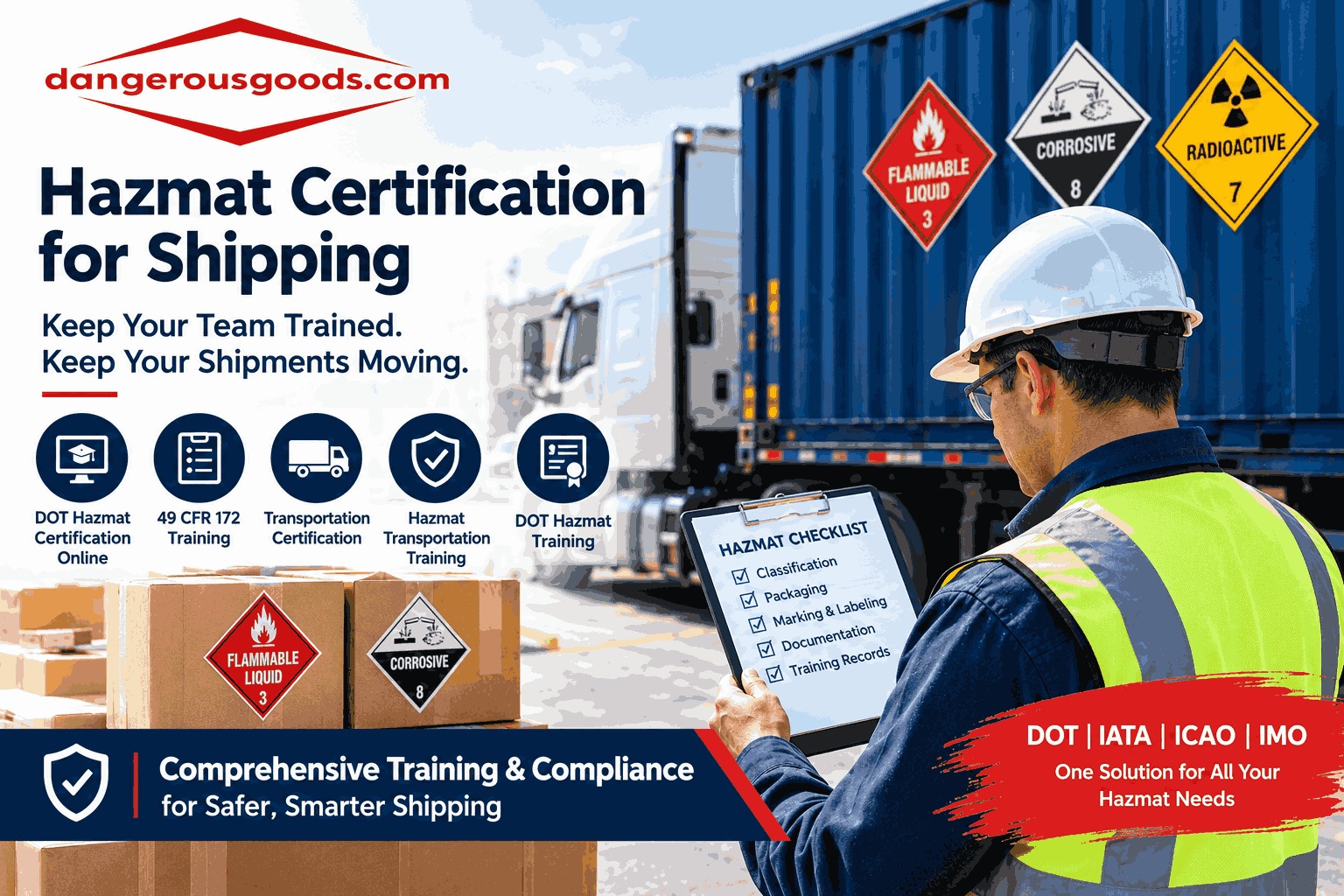
Hazmat Certification for Shipping

Hazmat Certification for Shipping: A Practical Guide for Shippers

You’ve probably seen it happen. A truck backs up to the dock and frowns. Somebody used the wrong shipping name, and now the load sits while everyone argues. That’s an expensive way to learn why Hazmat Certification for Shipping exists. If your company moves anything flammable, corrosive, or toxic, trained people aren’t optional. They’re the difference between a routine pickup and a very long evening. So here’s how it all works, minus the legal fog.

Which Employees Actually Need It?

More than just the driver. The U.S. definition of a hazmat employee is wider than what many managers think. It includes whoever packages the cargo or touches the shipment prior to departure. Sure, this may include the employee from accounting who writes out the description. All must be trained within 90 days of employment and retrained at least every three years thereafter. Many organizations learn the hard way when they fail to do so, usually during an audit – worst-case scenario. This will ensure proper Hazmat Certification for Shipping. 

Inside 49 CFR 172 Training

Part 172 is where the day-to-day rules live. Think of it as the language packages speak. What goes on the shipping paper. Which marks and labels belong on a box. When a vehicle needs placards and what emergency information has to travel with the load. A decent 49 CFR 172 Training session walks you through the Hazardous Materials Table line by line. Since that’s where most mistakes begin. Then it layers on security awareness and lessons for your specific job. A forklift operator doesn’t need the same depth on documents as the person signing them. And good classes know that.

Weighing DOT Hazmat Certification Online

DOT Hazmat Certification Online is a popular search, and you can see why. Nobody wants to pull six people off the floor for two days. Just don’t pick on price alone. Before you sign anyone up, ask whether the material reflects recent changes to the regulations, whether there’s a test at the end, and whether you’ll receive a certificate to keep in each employee’s file. Also ask who you’d call with a question. Real DOT Hazmat Training should leave you with answers- not more confusion. A person on the other end of the phone matters more than most folks realize.

Transportation Certification Beyond the Road

Freight changes modes. A drum leaves Houston by truck, then boards a ship or gets bumped onto a plane. DOT covers the ground leg, but IATA and ICAO govern air cargo, and IMO handles ocean shipments, and they don’t all agree on details. That’s why Transportation Certification should match how you really ship. Not just how you hoped to. Look for Hazmat Transportation Training that spells out those differences. Instead of glossing over them if your team mixes modes.

More Than a Classroom

Training solves one problem. Plenty of others show up around it. Maybe you can’t tell how a chemical blend should be classified. You’re unsure what your packaging needs to survive a UN test. A full-service provider can step in on all of that: hazard classification and disposal. Add compliance consulting for DOT and IMO rules. And Hazmat Certification for Shipping turns into something your staff uses every day. Rather than a certificate collecting dust in a drawer.

The Cost of Winging It

Some shippers figure they’ll sort it out as they go. Occasionally that works. Then a drum gets rejected and the bill for guessing shows up all at once. Fines are higher than they used to be, and security checks are stricter. A few habits help: classify before you pack and file training records somewhere you can actually find them. With Hazmat Certification for Shipping behind your team, those habits stick.

Getting Your Team Ready

None of this has to be overwhelming. Make a list of everyone who touches hazardous freight and keep the records tidy. Check what your DOT Hazmat Certification Online choice includes and confirm your Transportation Certification covers every mode you use. Do that and Hazmat Certification for Shipping becomes a quiet strength instead of a nagging worry. Dangerousgoods.com, Inc. has trained and advised shippers across the Gulf Coast since 1980, so if you’d like a hand, they’re a phone call away.

Talk to a Hazmat Pro Today

Questions about training, certification, or packaging? Call 281-821-0859 or email larry.dangerousgoods@gmail.com for a free quote. We’re available 10 AM to 6 PM, and whether it’s one class or a full safety program, we’ll help you find the right next step.

1. Who has to complete hazmat training before shipping?

Anyone who packs, loads, labels, handles, or prepares paperwork for hazardous shipments qualifies as a hazmat employee under DOT rules. New hires need training within 90 days, and everybody refreshes it at least every three years afterward.

2. What topics does 49 CFR 172 training cover?

Expect shipping papers, marking, labeling, placarding, and emergency response information, along with the Hazardous Materials Table. Most courses also add security awareness, general safety, and job-specific lessons so each person learns what their own role requires.

3. Can online DOT hazmat training stand alone?

Sometimes, yes. Quality varies, though, so check that the course is current, includes testing, and provides a certificate for your records. For complex cargo, back it up with consulting or hands-on guidance from someone experienced.
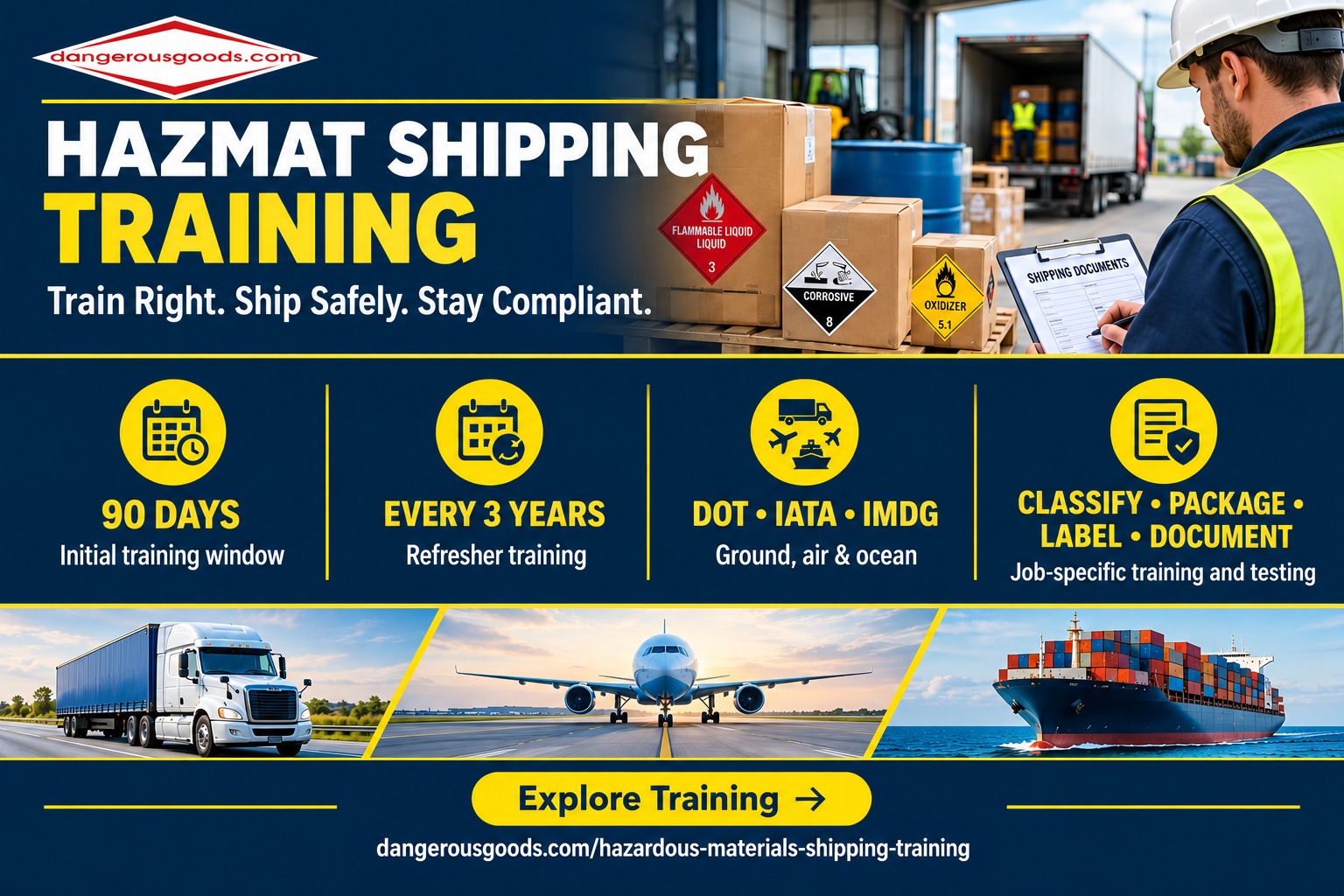
DOT Hazmat Training Requirements

DOT Hazmat Training Requirements: A Plain-English Walkthrough

Your newest warehouse hire starts Monday. By Wednesday, he’s taping up a box of lithium batteries because everyone else is busy, and he’s guessing at the label. Nobody’s being careless on purpose. It’s just a normal week on a busy dock. But that guess is exactly where DOT Hazmat Training Requirements step in, and where plenty of companies find out they’ve been winging it. The rules aren’t secret. They’re just tucked inside regulation text that reads like a tax form. So grab a coffee, and let’s pull out the useful parts.

Who Counts as a Hazmat Employee?

The coverage extends farther than you might realize. Loading and handling all qualify. In addition, so does the employee who prepares shipping documentation. The person who checks the containers and the driver who transports the material. The clerical worker who writes a description for the material on a bill of lading also qualifies as a covered person. Here is an exercise. Get out of your office and go through your building with a pad of paper and jot down the names of every employee. Who comes into contact with the hazardous materials. Even if it is just once a month. That list is the foundation for your training program.

The 90-Day Window and the Three-Year Loop

Timing trips up more companies than content does. When someone’s hired, or moves into a new hazmat job, you’ve got 90 days to finish their training. Until then, they work under the direct supervision of someone who’s already trained. After that, refresher training comes around at least every three years. Miss it by a week, and you’re technically out of compliance, even if the person knows the material cold. That’s the annoying part of DOT Hazmat Training Requirements: knowing your stuff doesn’t satisfy them. Proof does.

What 49 CFR 172 Training Actually Teaches

Subpart H of Part 172 lays out the building blocks. General awareness comes first, so people can recognize hazardous materials and get a feel for how the regulations are organized. Function-specific training follows, and it’s tied to the job each person does, not some generic overview. Then comes safety training: emergency response information, protective measures, and how to avoid exposure. Security awareness rounds out the list, and some employers also need in-depth security training, depending on their security plan. Good 49 CFR 172 Training gets hands-on with shipping papers, marks, labels, and placards too. Somebody who can recite the rules but can’t spot a missing label hasn’t really learned much.

Is DOT Hazmat Training Online Legit?

It can be, yes. Plenty of teams use DOT Hazmat Training Online because shifts overlap, sites are scattered, and pulling six people off the floor for two days hurts. But the rules still demand testing, and the content has to fit the job. A one-size course for “all hazmat employees” rarely suits a truck driver and a drum packer equally. So ask before you buy. How’s the test scored? Does the material reflect recent rule changes? What records come with it? And if you need proof for your files, DOT Hazmat Certification Online programs should hand you a clear certificate, not make you chase one.

When Freight Switches Lanes

Your shipments might not stay on the road. A drum rolls out by truck, then it’s loaded onto a plane or a ship. DOT covers the ground side, IATA and ICAO cover air, and IMO covers sea, each with its own expectations. So Hazmat Transportation Training works best when it follows the way you actually move product, rather than the way a textbook assumes you do. If you only ship by truck, don’t pay for air modules you’ll never touch. If you mix modes, don’t settle for ground-only material.

Support Beyond the Classroom

Meeting DOT Hazmat Training Requirements is rarely the only item on your list. Maybe you’re unsure how a chemical blend should be classified. Maybe your drums need UN specification testing, or the safety data sheet hasn’t been touched in years. That’s where a full-service provider earns its keep. Look for one that offers hazmat consulting and spill response, cleanup, and disposal. Custom safety programs can pull everything together so each piece supports the next.

Slip-Ups Auditors Spot Fast

Auditors see the same problems over and over. A training record with no test score. An employee two months past the three-year mark. A trainer’s name missing. Employers must keep each person’s name, latest training date, the training materials or a description of them, the trainer’s name and address, and a certification that the person was trained and tested. Those records stay on file for as long as the person holds the job, plus 90 days. Put reminders on the calendar about ninety days before each refresher. Treat DOT Hazmat Training Requirements like a forklift inspection: scheduled, written down, and not somebody’s side project.

Turning Rules Into Routine

On paper, all this looks intimidating. In practice, it boils down to a few steps. Find everyone who touches hazardous freight. Train them for the work they actually do. Test them. Keep the records. Then do it again every three years. Pair solid 49 CFR 172 Training with Hazmat Transportation Training that fits your modes, and choose between DOT Hazmat Training Online and classroom sessions based on what your crew needs, not what’s easiest to schedule. Once DOT Hazmat Training Requirements become routine, shipping gets calmer, and audits stop feeling like ambushes. Dangerousgoods.com, Inc. has helped Gulf Coast shippers get there since 1980, from training and testing to consulting and UN packaging.

Book a Hazmat Consultation

Not sure where your team stands? Call 281-821-0859 or email larry.dangerousgoods@gmail.com to ask about training classes, testing, or consulting. We’re open 10 AM to 6 PM, and you can request a free quote anytime. Let’s get your people trained the right way.

FAQs

1. How often is DOT hazmat training required?


New hazmat employees must complete training within 90 days of hire or a job change, working under supervision until then. After that, refresher training comes around at least every three years, and again whenever their duties change.

2. What training records must employers keep?


Employers must keep the employee’s name, latest training date, a copy or description of the materials, the trainer’s name and address, and a testing certification. Records stay on file for the employee’s tenure plus 90 days.

3. Is online training accepted for DOT hazmat compliance?


Yes, online courses can satisfy the rules when they cover general awareness, function-specific, safety, and security topics, include testing, and match the employee’s actual job. Make sure the provider also issues clear records you can show an auditor.

DOT Hazardous Materials Training Requirements

What You Actually Need to Know About the DOT Hazardous Materials Training

When hazardous materials move from a warehouse to a customer, one mistake can turn into a real problem fast. A wrong label. An employee who never got proper training. Either one can hit both safety and compliance at once. That’s why understanding DOT Hazardous Materials Training Requirements isn’t just some paperwork exercise to check off. It’s part of actually getting your team ready to handle dangerous goods the right way.

Know Who Needs Hazmat Training

If your employees touch anything connected to hazardous materials transportation safety, their training needs to match what they’re actually responsible for — that’s really the whole logic behind DOT Hazardous Materials Training Requirements in the first place. That covers people doing packaging, marking, labeling, paperwork, loading, shipping, receiving, and other transportation-related tasks.

This is where DOT Hazmat Training earns its keep. A structured program gives employees a clearer sense of what they’re handling and why certain steps matter, not just that they matter. It also helps supervisors spot where someone needs more guidance before a shipment goes out the door.

Dangerousgoods.com builds programs around what your company actually needs. Classes cover safe handling and transportation, working through paperwork, packaging, marking, labeling, and segregation along the way. Students get tested and certified once they finish.

Connect Training With Daily Shipping Work

Good training links regulations to the work people actually do every day. Reading a rule is one thing. Knowing how to apply it while you’re standing there prepping a shipment is a different skill entirely.

Dangerousgoods.com focuses training on the practical side of things. Employees learn how the regulatory requirements actually connect to packaging, documentation, marking, labeling, and safe handling, not just abstract rules on a slide.

That approach makes training a lot easier to use once real pressure hits. Nobody wants to stop halfway through an important shipment wondering which requirement got missed.

Choose Hazardous Materials Transportation Training

Your training program should fit the materials you handle, and the actual transportation work your team does. Highway, air, rail, and ocean shipments each come with their own regulatory quirks. Job-specific Hazardous Materials Transportation Training makes the information a lot easier to apply on the job. Once employees see how a regulation connects to their own tasks, compliance stops feeling like some separate office requirement handed down from above.

Dangerousgoods.com offers training for both domestic and international shipping. Classes can run right at your facility, which helps a lot when several employees need training at once. The company brings instructors, manuals, testing, and certification along with its in-house programs.

Support Beyond the Classroom

Training is only one piece of a solid hazmat compliance approach. Your company might also need help with classification, packaging, shipping paperwork, safety inspections, SDS review, and regulatory questions that come up along the way.

Dangerousgoods.com offers related services including on-site HAZMAT safety inspections, hazard classification, UN Specification packaging design and testing, hazardous materials packing services, spill response support, SDS review and preparation, and DOT, IATA, ICAO, and IMO compliance consulting.

That wider support matters when a shipping question doesn’t fit neatly into a training manual. Sometimes the hard part isn’t knowing a rule exists. It’s knowing which rule actually applies to your situation.

Keep Training Current

Regulations shift. Workplace duties shift too. Employees move into new roles or suddenly take on different shipping tasks than what they were originally trained for, which is exactly why DOT Hazardous Materials Training Requirements call for regular refreshers instead of a one-and-done approach. That’s exactly why training records and refresher planning matter as part of your compliance process, not an afterthought.

The Dangerousgoods.com training page notes that recurrent Hazmat Transportation Training is required at least every three years under the applicable requirements. Your company should keep track of training records and make sure employees get instruction. That actually matches their responsibilities. Staying organized here also makes it a lot easier to spot who needs a refresher and when.

Put Practical Knowledge First

Hazmat rules can feel like a tangled mess when you are juggling several regulations at once. Practical instruction cuts through that because employees can connect the rules directly to tasks they are already doing every day.

They have provided hazardous materials training and consulting since 1980. Their approach blends regulatory knowledge with real and hands-on experience in transportation and safe handling.

Understanding DOT Hazardous Materials Training Requirements gives you a stronger foundation for compliance overall. It helps employees actually recognize what they’re responsible for before a shipment ever leaves your facility.

Conclusion

Safe hazardous materials transportation starts with people who understand their own roles. DOT Hazardous Materials Training Requirements should shape your training plan. But the real goal is practical knowledge employees can actually use during everyday shipping work. With customized classes and compliance consulting, Dangerousgoods.com can help your team approach hazmat transportation with a lot more clarity and confidence.

Build a Stronger Hazmat Training Plan

Ready to strengthen your hazmat compliance process? Contact Dangerousgoods.com at 281-821-0859 to talk through customized training and compliance consulting built around your team and regulatory needs. Get practical guidance before your next shipment goes out.

FAQs

1. Who needs DOT hazmat training?

Employees whose work directly affects hazardous materials transportation safety generally need training. That includes people involved in packaging or other duties connected to hazardous materials transportation.

2. How often should hazmat employees receive recurrent training?

Dangerousgoods.com notes that recurrent training is required at least every three years under applicable requirements. Your company should also revisit responsibilities whenever employees change roles or start handling different hazardous materials than before.

3. Can Dangerousgoods.com provide training at our facility?

Yes. Dangerousgoods.com offers in-house classes and can bring the instructor and certification right to you. This option works well when several employees need training without having to travel away from the workplace.

What Does DOT 49 CFR Training Cover for Safer Hazmat Shipping?

What Does DOT 49 CFR Training Cover for Safer Hazmat Shipping?

A hazardous materials shipment can look totally ordinary right up until one small detail goes sideways. Maybe the package got marked wrong. Maybe an employee isn’t sure what paperwork actually goes with it. Maybe a shipment sits in the loading area, and nobody’s quite sure which rule even applies here. These are exactly the moments DOT 49 CFR Training exists for. Once you actually understand what the regulations require, you can get your team ready to handle hazmat responsibilities with more care and a lot more consistency.

Start With the Rules Your Team Uses

Hazmat regulations cover a lot more than just putting a dangerous product in a box and shipping it off. Your employees might have responsibilities touching packaging, labeling, marking, documentation, loading, receiving, classification, or transportation itself.

They explain that hazmat employees whose work directly affects transportation safety need training that actually matches their job function. Their programs are built around both general awareness and job-specific responsibilities under the applicable regulations.

That distinction matters more than it sounds, and it’s really the starting point for any serious DOT 49 CFR Training program. Your shipping clerk probably doesn’t need the exact same instruction as someone preparing packages or handling classification. Training should track the actual job, not a generic checklist.

Why DOT Hazmat Security Awareness Training Matters

Safety and security tend to overlap once you’re moving dangerous materials around. Employees need to understand their responsibilities and recognize the kinds of situations that could create risk nobody planned for.

DOT Hazmat Security Awareness Training helps build that awareness right into a broader hazmat training program. Instead of treating security like an afterthought bolted on at the end. You can fold it into how employees approach their everyday work.

The point isn’t to make shipping complicated. It’s to get your people to pause when something looks off and know when it’s worth asking someone else.

Build Skills Through Hazmat Shipping Training

Good Hazmat Shipping Training should feel connected to actual work- not a classroom exercise disconnected from the floor. If your employee is prepping a shipment at 3 p.m. on a busy Friday. They need knowledge they can actually use in that moment, not theory.

They build customized training programs around what your company specifically needs. Instructors cover regulations, paperwork, packaging, marking, labeling, segregation, and whatever else goes into safely preparing and shipping dangerous goods. Students get tested and certified once they’re done.

That practical focus makes a real difference. You’re not just checking a box that says training happened. You’re actually helping people understand what’s expected of them.

Understanding 49 CFR 172 Training Requirements

A lot of hazmat training conversations eventually circle back to Title 49 of the Code of Federal Regulations. 49 CFR 172 Training requirements sit within the Hazardous Materials Regulations, specifically under 49 CFR Part 172 Subpart H.

It describes training as a systematic program built around a consistent approach, testing, and documentation. They also point to Sections 172.700 and 172.704 when talking through hazmat employee training specifically.

Your training records should be treated as a real part of the process, not just paperwork to file away. A certificate on its own doesn’t tell the whole story. Your company needs to know who got trained, what responsibilities were actually covered, and when the next recurrent training is due.

Make Training Easier With In-House Classes

Pulling an entire team away from the workplace isn’t always realistic. Production schedules don’t just pause because training landed on the calendar.

They offer in-house classes right at your facility. They bring the instructors and manuals, along with testing and certification for anyone who completes the program. This works especially well when several employees need training at the same time.

You also get to ask about workplace-specific questions during the session itself. That helps a lot when your shipping process has a few unusual steps that a generic course would never touch.

Go Beyond Training When Needed

Sometimes training uncovers a bigger compliance question underneath it. Maybe you need help classifying a product. Maybe it’s picking the right packaging, reviewing an SDS, or checking a shipment before it actually moves.

They also offer on-site hazmat safety inspections, hazard classification, UN Specification packaging design and testing, hazardous materials packing services, SDS review and preparation, spill response assistance, and DOT, IATA, ICAO, and IMO compliance consulting.

Having all of that available makes it a lot easier to catch a problem before it turns into an actual shipment issue.

Keep Your Compliance Knowledge Current

Hazmat responsibilities don’t just end once someone finishes a class. Regulations change over time. Job duties shift too. Someone who used to handle receiving might end up responsible for shipping documentation or packaging a year later.

We state that recurrent training is required at least every three years under the applicable requirements. Your company should track training dates and revisit employee responsibilities whenever duties actually change.

This is exactly where DOT 49 CFR Training becomes an ongoing part of your safety process, not some once-every-few-years task you check off and forget.

Conclusion

Understanding DOT Hazardous Materials Training Requirements helps you build a training plan around what your employees are actually responsible for- not a generic template. With customized classes and compliance consulting. Dangerous goods can help you approach hazmat transportation in a much more organized way.

Whether you need DOT 49 CFR Training for a small team or broader support across your whole shipping operation. The right instruction gives your employees clearer direction and helps you avoid mistakes that were entirely preventable.

Get Your Hazmat Training Started

Need help preparing your team? Contact Dangerousgoods.com at 281-821-0859 for customized hazmat training and compliance consulting. That is tailored to your shipping responsibilities and workplace needs.

FAQs

1. Who should receive DOT hazmat training?

Employees whose work directly affects hazardous materials transportation safety should get training that matches their duties. That can include people involved in packaging or other regulated transportation functions.

2. What does 49 CFR hazmat training cover?

Training can cover general awareness and other requirements. What exactly gets covered should reflect the employee’s assigned hazmat duties and the transportation work they actually do.

3. Can Dangerousgoods.com train employees at our facility?

Yes. Dangerousgoods.com offers in-house classes and brings instructors, manuals, testing, and certification right to you. This can be a practical option when several employees need training, and your company wants to cut down on unnecessary travel and disruption.